Scaling to 150 engineers, fully remote — with Zuhair Khayyat of Lucidya
As CTO of Lucidya, Zuhair Khayyat grew its engineering team from a handful of people to 150 across a dozen countries, interviewing 1,000+ candidates along the way. He breaks down the three pillars that make remote work actually work, why he hires for passion over pedigree, and 'the illusion of the senior.'
Same conversation, either way — the video is our Zoom call, the audio is that call’s soundtrack.
- Remote work stands on three pillars: transparency, inclusion, and trust. Remove any one and it collapses.
- "We don't monitor your activity. We only monitor your deliverables."
- The illusion of the senior: a fresh grad taught your way often out-returns a senior who arrives with baggage.
- "Skills, you can easily teach. But passion, you cannot teach that."
When Zuhair Khayyat joined Lucidya in 2017, the engineering team was him and one or two others. Today it's roughly 150 people spread across Saudi Arabia, Egypt, Jordan, Portugal, India, Pakistan, and beyond — most of them remote. As CTO, he's interviewed more than 1,000 candidates and hired over 300 along the way.
We sat down to unpack how he did it. What follows is an edited version of that conversation.
From ID number six to 150 engineers
Lucidya is a customer-experience management platform, and like most startups its early days were unpredictable. "My ID in the company is 6," Zuhair told me — there were five hires before him, most of whom moved on before the team found its footing. He started with two or three people on the technical side and built from there.
He's candid that retention in a fast-moving SaaS startup isn't glamorous: "Our retention numbers were not that great compared to international standards, but for a startup in the region, I think it's pretty decent." The proof is in the people who stayed. Fresh grads he hired in 2018 and 2019 now hold team-lead positions and are the domain experts across AI, SRE, backend, and frontend. "We built this company together. We made mistakes together. But we learned together."
Remote work, before it was cool
Lucidya didn't discover remote work during COVID — it was remote from day one. Zuhair had spent his PhD collaborating across the US and Qatar, learning to compensate for the missing body language of in-person work. The founders had run a previous company, Waqood Tech, the same way. "It was just the perfect mix."
COVID only proved the point. While the rest of the world scrambled, Lucidya kept growing without missing a beat. Zuhair rode it out from a makeshift desk in his in-laws' house — no dedicated room, no real setup — and his young son kept commandeering the equipment. He posted the evidence to Slack with a caption: look who's taking the office of the CTO.
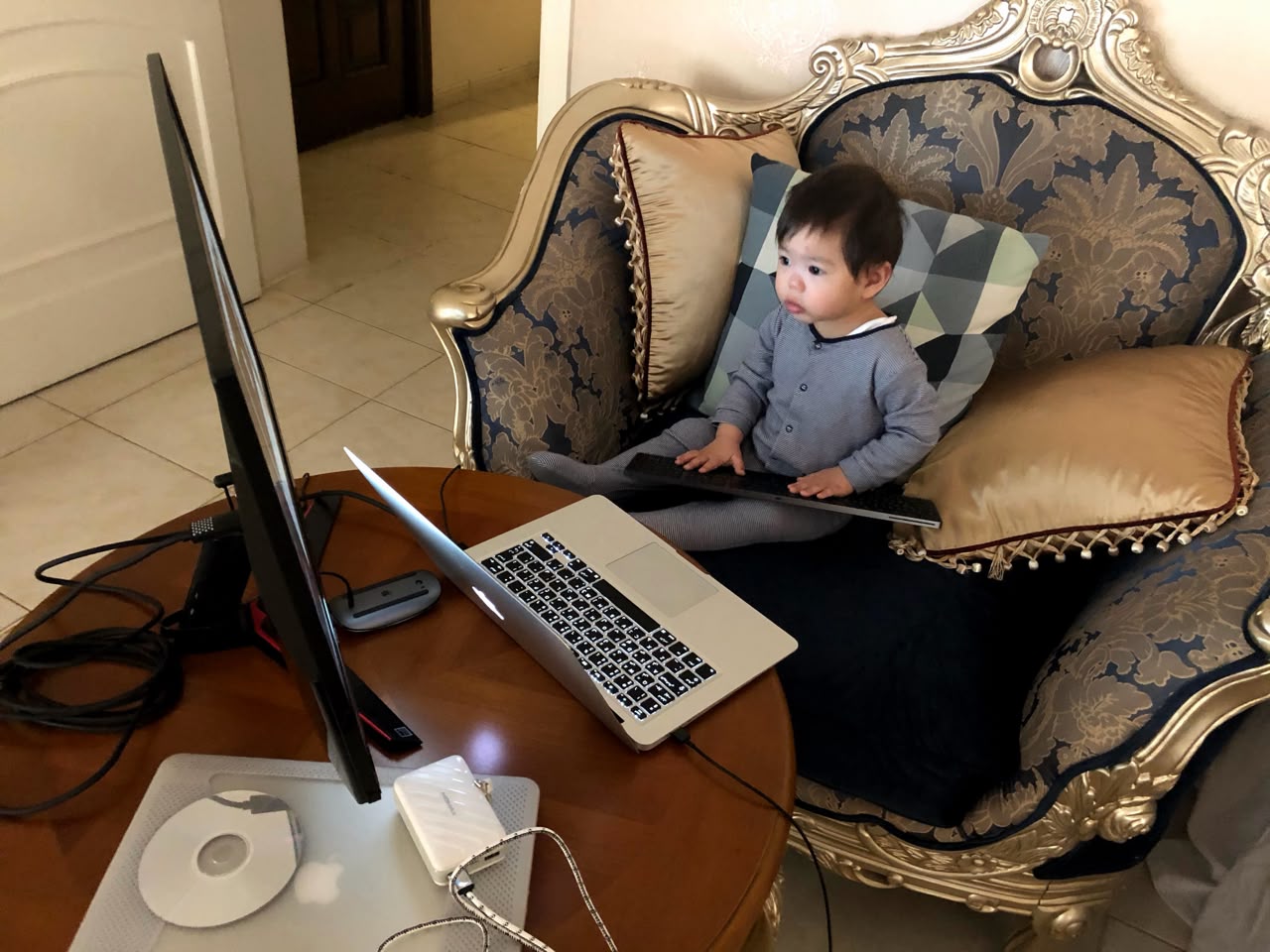
His argument for remote isn't about cost or convenience. It's about reach:
Remote work allows you to reach people that, in a conventional way, you are unable to reach. One of our amazing employees was working from a farm — in our calls I could hear chicken, goats, everything in the background. If you think that's not professional, no. You are giving people the space to innovate.
But he's equally clear that flexibility isn't free. "It doesn't remove the overhead of keeping the employee satisfied. It actually puts extra pressure on HR to make sure you include the people who work remotely."
The three pillars
Ask Zuhair why most remote teams struggle and he'll give you a structure, not a vibe. Remote work succeeds, he says, when three things hold — and fails when any one of them is missing.
1. Transparency
There's an "unspoken language" in an office — you overhear the wins, the challenges, the sense of belonging. Remote work quietly severs that, so you have to over-communicate on purpose. At Lucidya, Slack is the source of truth: dedicated channels per city and team, and a rule that anything announced verbally is always announced in Slack first. "If you're working remotely, it's very easy to burn out, very easy to feel that nobody cares about you. The psychological safety of the person has to be maintained."
2. Inclusion
An open-door policy, made literal: Zuhair publishes a booking link so anyone in the company can grab time with the CTO directly. The CEO is just as reachable. Quarterly all-hands sessions share not just successes but failures and lessons learned, open to questions from anyone. And for people who'd rather not speak up, HR runs a monthly anonymous employee NPS — an internal version of the customer metric — and acts on the patterns it surfaces.
3. Trust
This is the one Zuhair is most animated about. He has no interest in the surveillance theater of big companies — the mouse-jiggler memes, the always-green status light.
We give full trust to everybody. We don't monitor your activity. We only monitor your deliverables. It doesn't matter whether you wake up early or late, whether you take a break in the middle. We have deliverables weekly, monthly, quarterly — and we review the root cause when they're not met.
The counterpart to trust is discipline in communication. Lucidya has firm rules: respond to Slack within 30 minutes during working hours, acknowledge emails within two business days even if the full answer isn't ready. The point is to force asynchronous work. As Zuhair puts it: "Remote work without asynchronous work will not work."
The office question
Has he ever been tempted to just put everyone in a room? Lucidya does have offices in Riyadh and Jeddah, and will pay for co-working space anywhere else. But the answer is nuanced by role. Sales belongs in the field; customer support benefits from proximity; product often needs to be in the room to glue marketing, engineering, and sales together. Engineering, by contrast, thrives on focused, uninterrupted work.
He's measured the tradeoff directly:
When everybody works in the office one or two days, collaboration increases — but the actual work delivered is way less than when everybody is remote. So there should be a balance: enough meetups to build real relationships, but not so many that you kill the deep work.
The relationships still matter enormously. Lucidya runs regular in-person meetups by region, and last year flew team leads to Jeddah for a two-day leadership and emotional-intelligence workshop. "Not all the plans from that day worked," he laughs — "obviously" — "but the relationships that were built are strong until today."
Hiring: 1,000 interviews later
After more than a thousand interviews, I asked Zuhair who the winners are. He rejected the premise.
There are no winners or losers. There is the best fit. If you hire someone just because you need a body in that seat, in six months they'll leave — not because something's wrong with them or with you, but because the values didn't match.
Then he named something I've heard almost no one articulate this clearly — the illusion of the senior:
Companies always look for a senior and assume he'll solve everything. But a senior comes with baggage, with a fixed mindset. Bring in a fresh grad, teach them the way your company works, and there's often a higher return on investment than the senior. You have to be very careful that an experienced hire's mindset actually fits yours.
Which led to the line I'll remember longest from the whole conversation:
We have a minimum bar of skills everyone has to meet. But if you meet the bare minimum and you have the passion, that's the person we're looking for. Skills, you can easily teach. But passion — you cannot teach that.
One last piece of advice
I asked Zuhair what he'd tell someone about to go all-in on remote work. His answer wasn't about tools. It was about temperament.
First, be mentally ready. Have a routine that separates when it's work and when it's not, or the two blur together. Second, pay extra effort in how you write — a sentence can read as passive-aggressive purely from how it's phrased. And never assume the other person understood you. Explain once, twice, and if you sense a mismatch, ask them what they understood.
Get that wrong, he warns, and remote work curdles fast: "You'll feel like everybody is against you, like nobody cares — and eventually you'll look for another job. That's four to six months wasted from your life." Get it right, and you can build what he has: a durable, borderless team that's still growing.
Field Notes is a Courtix series of conversations with the engineers and leaders building serious software. If you're a technology leader with a story worth telling, get in touch.